The SHARE Approach: a brief clinician training program to enhance shared decision making skills.

Who can Benefit?

Anyone on the practice team can benefit from the SHARE Approach and using shared decision making. Clinicians, staff, and even patient partners.

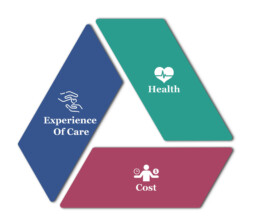
Aligned with the Triple Aim

Shared decision making can help your organization or practice meet the three aims of the U.S. Department of Health and Human Services National Quality Strategy and the Institute for Healthcare Improvement’s Triple Aim Initiative.
Facilitator's Guide

The SHARE Approach: 3 Modules and In-Person Exercises

We recommend first looking through the Facilitator’s Guide (click here). Details for each module are listed below.

Essential Elements of Shared Decision Making. In this course, you’ll learn to:

  • Define “shared decision making” in healthcare
  • Communicate to patients that there are decisions to be made
  • Describe the 5 elements of the SHARE Approach and how to apply them

First, watch the Essential Elements video (click here).

Next, please complete 2 in-person exercises:

You can use the Conversation Starters handout (click here) as part of Module 1. This handout will give you several prompts to engage with patients for each of the 5 elements of SHARE Approach. You can roleplay these during training, or use in your practice.

Decision Aids: What They Are and How to Implement Them. In this course, you’ll learn to:

  • Identify what a patient decision aid is and the benefits of using one; distinguish decision aids from patient education material.
  • Learn where to find decision aids.
  • Identify how to use different kinds of decision aids.

First, watch the Decision Aids video (click here).

Next, please complete 1 in-person exercise:

You can search for decision aids at your institution or other institutions. Many of these can meet national guidelines. Here are 2 websites that include a large number of decision aids about various topids:

Communication: Barriers and Solutions. In this course, you’ll learn to:

  1. Explore common communication challenges that make shared decision making deceptively difficult.
  2. Explain the impact of health literacy on patient understanding.
  3. Describe techniques to better communicate health numbers in a way patients can understand.
  4. Learn the teach-back method to facilitate understanding and communication.
  5. Learn how to make a recommendation in a patient-centered way.
  6. Identify strategies to support shared decision making among diverse patients with an array of social challenges.

First, watch the Communication video (click here).

Next, please complete 3 in-person exercises:

There are 3 handouts for Module 3. You can use these while learning, or as a quick refresher afterwards.

The Communicating Numbers to Your Patients handout (click here) will help ensure your patients are understanding risks and benefits in your discussions.

The Teach-Back Method handout (click here) offers guidance on how to repeat back to patients what you hear them saying, and vice-versa, to ensure understanding. What you say isn’t always what people hear.

The Cultural Competency handout (click here) will help you identify strategies to support shared decision making among diverse patients with an array of social challenges.

University of Colorado, School of Medicine | Legal Notices | Privacy Policy

The Patient decision aids on this website are licensed under a Creative Commons Attribution-NonCommercial-NoDerivatives 4.0 International License.The material provided on this website is for informational purposes only and is not provided as medical advice. Nothing contained in these pages is intended to be for medical diagnosis or treatment. Any individual should consult with his or her own physician before starting any new treatment or with any question you may have regarding a medical condition. No personal health information will be collected from users. Contact information is only collected if the user requests additional information regarding one of the tools. Last Updated 10/31/2019

Funding by the National Institutes on Aging (1K23AG040696) and the Patient-Centered Outcomes Research Institute (PI000116-01).